Ammonium Bifluoride
Description
A powerful etching and cleaning agent used extensively in glass frosting, metal pickling, and oil field acidizing. Preferred over HF in many applications due to safer handling characteristics while delivering equivalent fluoride activity.
Product Photos
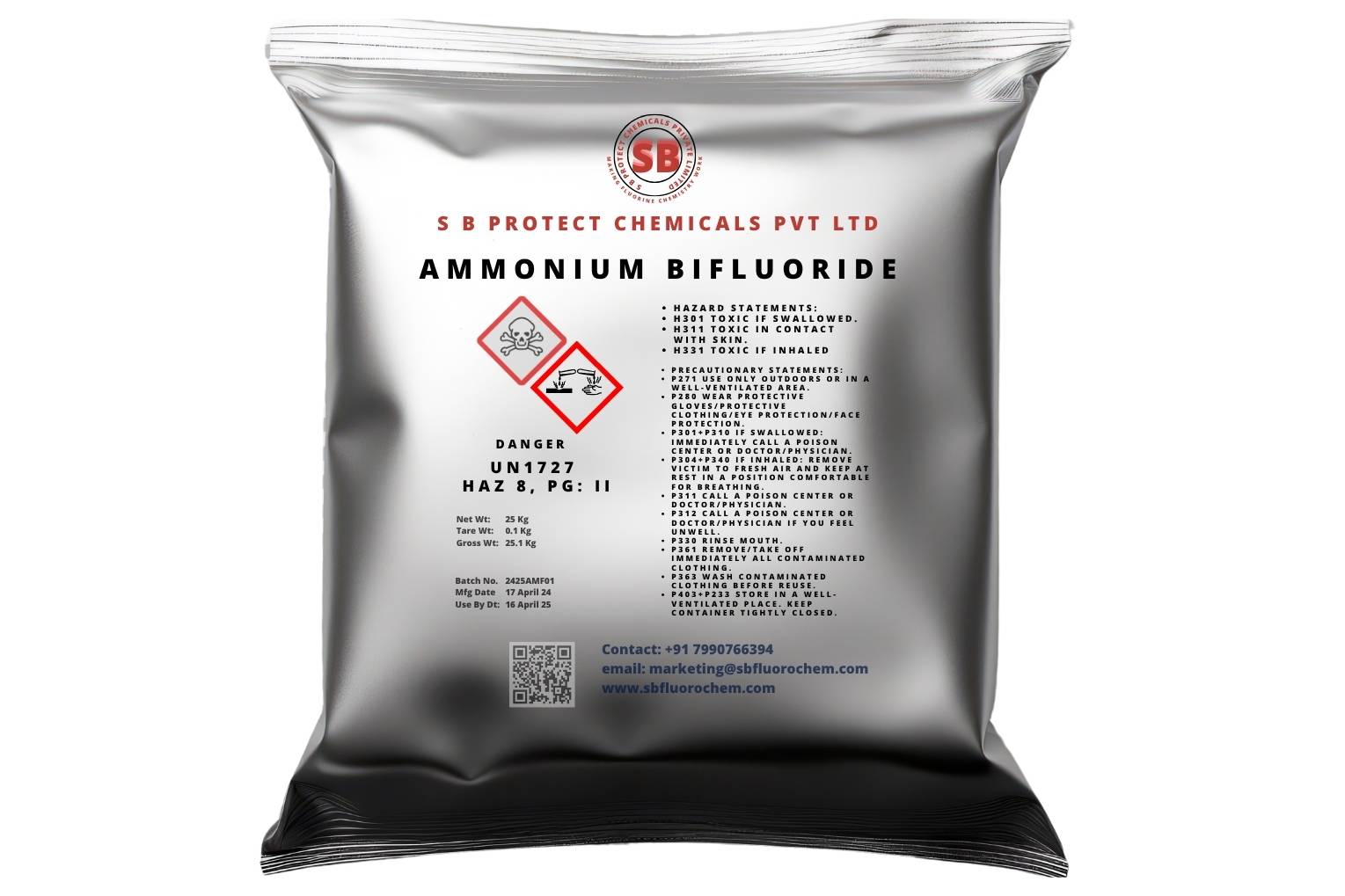
Specification
| Purity | 98%+ |
| Appearance | White flakes/crystite |
| Melting Point | 126°C |
| IUPAC Name | Ammonium hydrogen difluoride |
| Molecular Weight | 57.04 g/mol |
| Grades Available | Technical / LR / AR / Electronic |
| HS Code (Export) | 28261910 |
| SB Chemicals SKU | SBF-1052 |
Applications
- Glass Etching
- Metal Surface Treatment
- Oil Well Acidizing
- Ceramic Processing
- Cleaning Agents
Industry Solutions
Authoritative References
Independent verification of Ammonium Bifluoride on third-party scientific databases:
Frequently Asked Questions about Ammonium Bifluoride
What forms of ammonium bifluoride do you supply?
ABF is offered as free-flowing fine powder (D50 50–100 µm), flake (mm-scale platelets), and pre-dissolved 30% aqueous solution. The flake form is preferred for oilfield acidising; the powder for laboratory and electronics use.
Is ammonium bifluoride suitable for oilfield well-stimulation acidising?
Yes. Our oilfield-grade ABF is supplied in 25 kg moisture-resistant bags, with assay 98.5% min, free fluoride 32% min, water-insoluble matter < 0.05%, and chloride < 0.05%. Bulk shipments to drilling-services contractors include certified UN-1727 packaging.
What is the transport class for ammonium bifluoride?
ABF is regulated under UN 1727 (solid) and UN 2817 (solution), Class 8 (corrosive), Packing Group II. We ship with full IMDG / DGR / ADR documentation and UN-certified packaging.
What is the standard packaging for Ammonium Bifluoride?
Ammonium Bifluoride is supplied in HDPE woven bags with inner LDPE liner (25 kg / 50 kg net), HDPE drums (25 / 50 / 250 kg), and FIBC jumbo bags (500 / 1000 kg) for solid grades. Liquid grades ship in HDPE-lined steel drums (250 kg) or 1000 L IBC totes. Custom packaging — including nitrogen-blanketed, moisture-tight, or food-grade containers — is available on request.
What is the minimum order quantity (MOQ) and typical lead time?
Standard MOQ is 1 metric tonne for solid grades and 200 kg for liquid grades; pilot quantities of 5–25 kg are available for R&D qualification. Stock items dispatch within 7–10 working days from confirmed PO. Made-to-order grades and large export consignments require 3–4 weeks. Indian deliveries by road typically reach 4–7 days; export FCL shipments depend on destination port.
Do you provide MSDS / SDS and a Certificate of Analysis (COA)?
Yes. A 16-section GHS-format SDS is dispatched with every shipment and is also available in advance from marketing@sbfluorochem.com. A batch-specific COA accompanies every consignment and is emailed before dispatch for goods-receipt verification. Test methods follow IS / ASTM / USP / IP / EP as applicable.
Which countries do you export to and what Incoterms do you offer?
SB Chemicals exports to over 35 countries across South-East Asia, the Middle East, Africa, Europe, and the Americas. We hold IEC, GST, and APEDA registrations. Shipments move CIF / FOB / CFR / FCA / EXW from Mundra, Nhava Sheva (JNPT), or Hazira ports. Letter of Credit (LC), TT, and DA terms are accepted subject to credit approval.
Are your products manufactured to ISO 9001:2015 quality standards?
Yes. SB Chemicals operates an ISO 9001:2015 certified Quality Management System at the GIDC Vapi facility. Every batch undergoes raw-material testing, in-process control, and final QC release before despatch. Clients are welcome to schedule a third-party audit of the plant.
Related Products
Quick Facts
Specification data last reviewed: 26 Oct 2026
Safety & Transport
Safety Data Sheet (SDS) available on request. Contact us for regulatory documentation.
Packaging
25 kg HDPE bags, 50 kg drums

Need This Product?
Bulk price, sample and COA within one working day.
✉ Request quotation 💬 WhatsAppProduct Reference Data
Chemistry & Physical Properties
Ammonium hydrogen fluoride, formula NH4HF2 (or NH4F·HF), formula weight 57.04 g/mol. White crystalline flakes or prills with characteristic ammoniacal odour. Melting point 126°C. Density 1.50 g/cm3. Highly water-soluble (~63 g/100mL at 20°C). Aqueous solutions are strongly acidic (pH ~3.5 at 1% solution) and release HF on contact with stronger acids.
Standards & Specifications
Industrial grades conform to generic supplier specifications and IS 9966-2 for inorganic fluorides. Glass-etching grade typically targets 98%+ assay with controlled chloride content (< 0.1%). USP and EP grades are not commonly specified for this compound. Reference standards include ASTM C1191 for industrial fluorides.
Regulatory & Transport Profile
CAS 1341-49-7. UN 1727 — Class 8 (Corrosive), PG II. GHS pictograms: GHS05 (corrosive), GHS06 (toxic), GHS09 (environmental hazard). REACH registered (EC 215-676-7). TSCA listed. Special transport rules: SAFEX/IATA/IMDG require HF-rated PPE and calcium gluconate first-aid availability.
Available Grades
| Grade | Typical Specification | Common Use |
|---|---|---|
| Technical | 95-97% | Oil-well acidizing, metal pickling |
| Glass-Etching Grade | 98%+ low-Cl | Glass frosting, decorative glassware |
| LR / AR | 99%+ | Laboratory and analytical reagent |
| Microelectronic Grade | 99.9%+ low-metals | Wafer etching, semiconductor processing |
Product Information & Resources
Frequently Asked Questions
- How does it compare to HF acid for glass etching?
- NH4HF2 is the preferred form because it is a free-flowing solid rather than a liquid acid — safer to handle, store, and dose precisely.
- Does it release HF on storage?
- Sealed containers in cool, dry conditions are stable for 24+ months. Moisture ingress will cause slow HF release — keep packaging tight.
- Available in flake or powder?
- Both — flake (5-15mm) for free-flowing dosing, powder for dissolution applications, and prills for automated handling.
- What MOQ applies?
- 25 kg minimum for stock items. Sample lots of 100-500g available for technical evaluation.
Product Name in Other Languages
Authoritative References & External Data Sources
For peer-reviewed property data, regulatory listings, and structure verification: