Synthetic Cryolite
Description
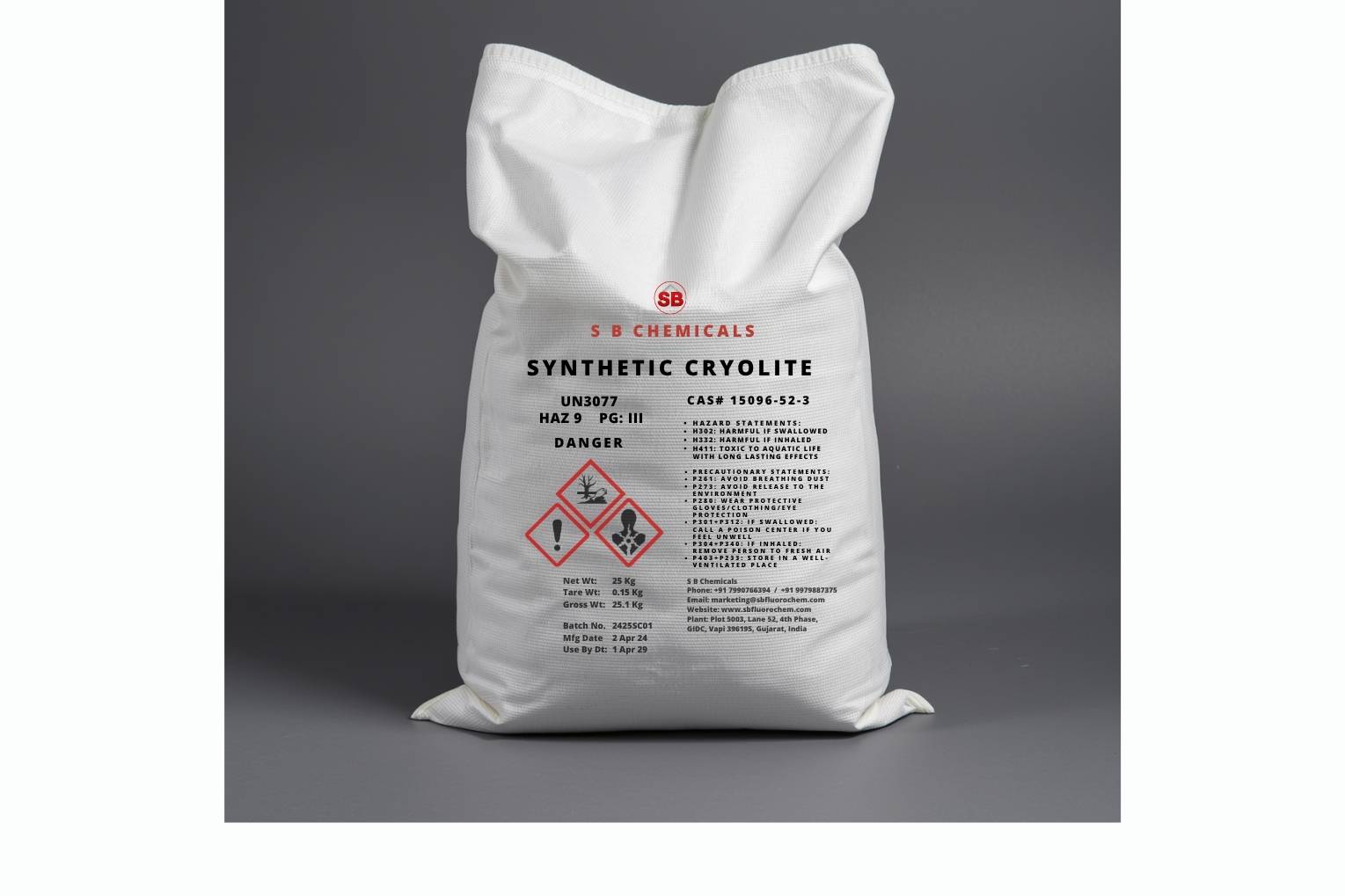
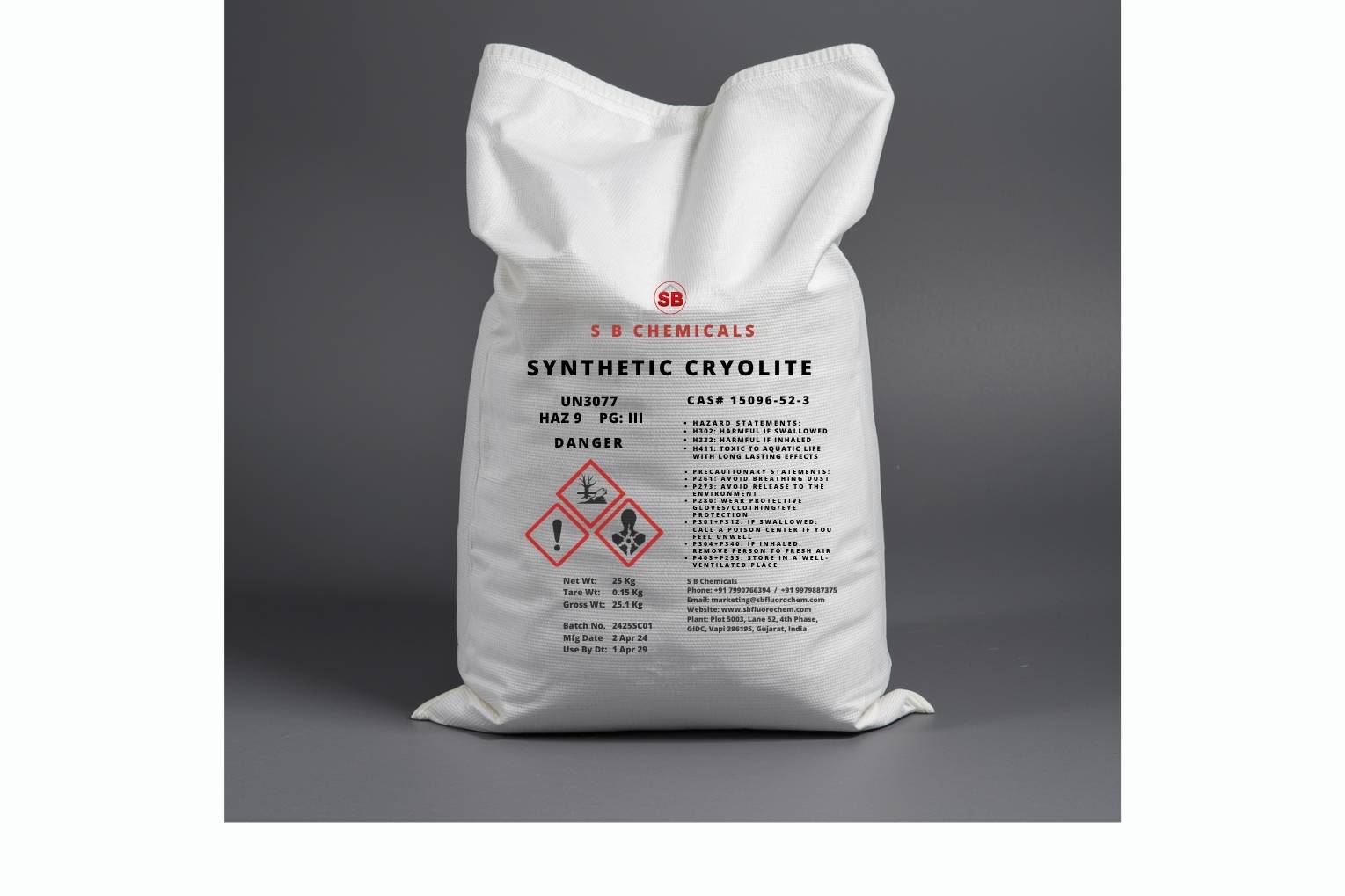
Synthetic cryolite is a cornerstone product in aluminium metallurgy, abrasive manufacturing, and ceramic processing. In aluminium smelting, it serves as the electrolyte bath medium. In abrasives, it acts as a grinding aid filler in resin-bonded wheels. Also used in enamel frits, glass opacification, and welding electrode coatings.
Product Photos

Specification
| Purity | 96–98% |
| Na₃AlF₆ Content | 97% min (typical) |
| Appearance | White powder/granules |
| Mesh | Various grades available |
| IUPAC Name | Sodium hexafluoroaluminate |
| Molecular Weight | 209.94 g/mol |
| Grades Available | Smelter-Grade / Welding-Flux Grade / Glass / Ceramic Grade |
| HS Code (Export) | 28261200 |
| SB Chemicals SKU | SBF-1067 |
Applications
- Ceramics
- Abrasives
- Fluxes
- Aluminium Smelting
- Welding
- Glass
- Pyrotechnics
Industry Solutions
Aluminium Smelting & Metallurgy
Fluxes, bath additives, grain refiners for primary and secondary aluminium production
Glass & Ceramics
Etching, frosting, glazes, enamels, and opacification agents
Brazing & Welding Fluxes
Flux formulations for aluminium brazing, soldering, and welding electrode coatings
Abrasives & Refractories
Grinding aids, filler materials, and refractory components
Authoritative References
Independent verification of Synthetic Cryolite on third-party scientific databases:
Frequently Asked Questions about Synthetic Cryolite
What Na/Al ratio and particle size do you offer?
Synthetic cryolite is supplied at Na/Al molar ratios of 1.5:1 to 2.85:1 (sub-stoichiometric to stoichiometric). Smelter-grade is sized to D50 ≈ 30 µm (free-flowing fine powder); welding-flux grade is sized to 100–200 µm granular. Custom Na/Al ratios and PSDs are made-to-order.
What is the fluoride and alumina content typical of your smelter-grade cryolite?
Smelter-grade cryolite assays F 52% min, Al 12.5–13.0%, Na 30–32%, with SiO₂ < 0.25%, Fe₂O₃ < 0.05%, P₂O₅ < 0.02%, and SO₄ < 0.5%. Bulk density is 0.85–1.05 g/cc. Each consignment is supplied with full XRF and wet-chemistry COA.
Is synthetic cryolite a regulated transport good?
Cryolite is regulated under UN 3288, Class 6.1 PG III. We ship in 1000 kg FIBC jumbo bags or 25 kg laminated HDPE bags with full IMDG / ADR / DGR documentation.
What is the standard packaging for Synthetic Cryolite?
Synthetic Cryolite is supplied in HDPE woven bags with inner LDPE liner (25 kg / 50 kg net), HDPE drums (25 / 50 / 250 kg), and FIBC jumbo bags (500 / 1000 kg) for solid grades. Liquid grades ship in HDPE-lined steel drums (250 kg) or 1000 L IBC totes. Custom packaging — including nitrogen-blanketed, moisture-tight, or food-grade containers — is available on request.
What is the minimum order quantity (MOQ) and typical lead time?
Standard MOQ is 1 metric tonne for solid grades and 200 kg for liquid grades; pilot quantities of 5–25 kg are available for R&D qualification. Stock items dispatch within 7–10 working days from confirmed PO. Made-to-order grades and large export consignments require 3–4 weeks. Indian deliveries by road typically reach 4–7 days; export FCL shipments depend on destination port.
Do you provide MSDS / SDS and a Certificate of Analysis (COA)?
Yes. A 16-section GHS-format SDS is dispatched with every shipment and is also available in advance from marketing@sbfluorochem.com. A batch-specific COA accompanies every consignment and is emailed before dispatch for goods-receipt verification. Test methods follow IS / ASTM / USP / IP / EP as applicable.
Which countries do you export to and what Incoterms do you offer?
SB Chemicals exports to over 35 countries across South-East Asia, the Middle East, Africa, Europe, and the Americas. We hold IEC, GST, and APEDA registrations. Shipments move CIF / FOB / CFR / FCA / EXW from Mundra, Nhava Sheva (JNPT), or Hazira ports. Letter of Credit (LC), TT, and DA terms are accepted subject to credit approval.
Are your products manufactured to ISO 9001:2015 quality standards?
Yes. SB Chemicals operates an ISO 9001:2015 certified Quality Management System at the GIDC Vapi facility. Every batch undergoes raw-material testing, in-process control, and final QC release before despatch. Clients are welcome to schedule a third-party audit of the plant.
Related Products
Quick Facts
Specification data last reviewed: 26 Oct 2026
Free calculator
Convert bath analysis (excess AlF₃, CaF₂, Al₂O₃) to cryolite ratio / bath ratio, and size the AlF₃ addition needed to reach a target ratio.
Open the Cryolite Ratio & Excess AlF₃ Calculator →Safety & Transport
Safety Data Sheet (SDS) available on request. Contact us for regulatory documentation.
Packaging
25 kg / 50 kg bags, 500/1000 kg jumbo bags

Need This Product?
Bulk price, sample and COA within one working day.
✉ Request quotation 💬 WhatsApp